


In recent years, China's adhesive industry has shown a continuous, fast, and stable growth trend, with adhesive production and sales continuing to grow at a high speed. With technological advancements and the growing awareness of environmental protection and resource conservation, the demand for high-performance, eco-friendly adhesives will further expand. At the same time, compared to mid- and low-end adhesives, high-performance, eco-friendly adhesives have higher profit margins and wider applications, with a promising future.
Key data in this article: Production of adhesives and sealants in China, sales of adhesives in China, market share of various types of adhesives in China.
China's adhesive industry has experienced steady growth in production and sales, with an average annual sales growth rate exceeding 6.5%.
Adhesives, also known as glues, are substances that can bond two surfaces together. Compared to other bonding methods, adhesives are lighter, distribute stress more evenly at the bonded area, offer higher strength, and are more fatigue-resistant.
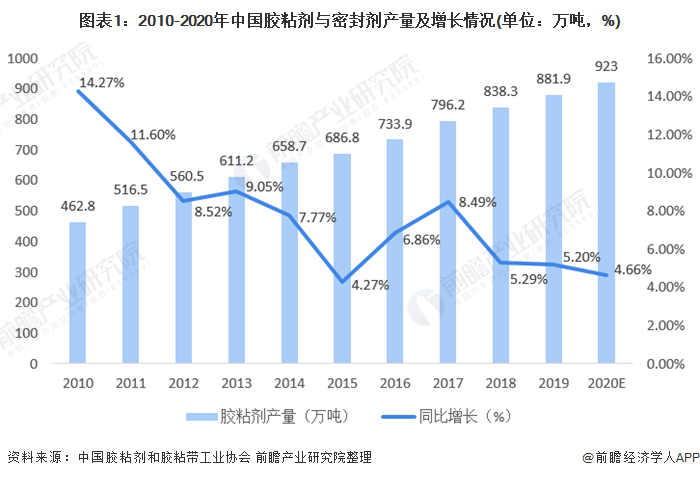
According to data from the Adhesive and Tape Industry Association, since 2010, China's adhesive production has maintained a growth rate of over 4%, and in 2019, the industry's production reached about 8.819 million tons, a year-on-year increase of 5.20%. Preliminary estimates show that in 2020, adhesive production in China reached 9.23 million tons, a year-on-year increase of 4.66%.
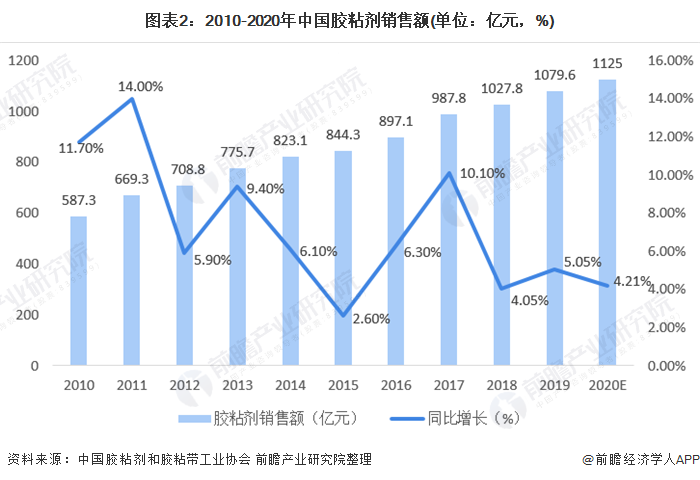
Looking at sales, with continuous technological progress, China's adhesive industry has seen sales grow year by year since 2010. In early 2020, preliminary estimates put China's adhesive industry sales at about 112.5 billion yuan, up 4.21% year-on-year. Sales in China's adhesive industry grew from 58.73 billion yuan in 2010 to 112.5 billion yuan in 2020, with an average annual compound growth rate of 6.72%.
Water-based adhesives are environmentally friendly and have the largest market share.
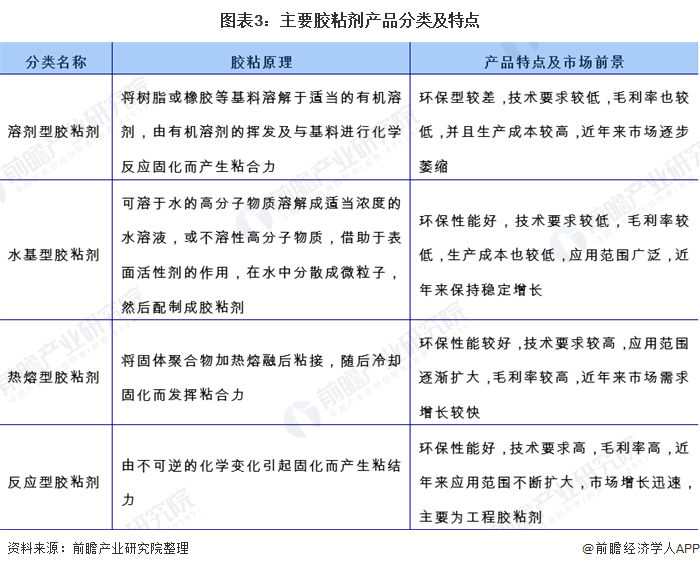
There are many types of adhesives, and the ways they are classified vary. Based on chemical composition and curing method, they can be divided into several main categories: solvent-based adhesives, water-based adhesives, hot melt adhesives, and reactive adhesives. The characteristics of each type are shown in the figure below.
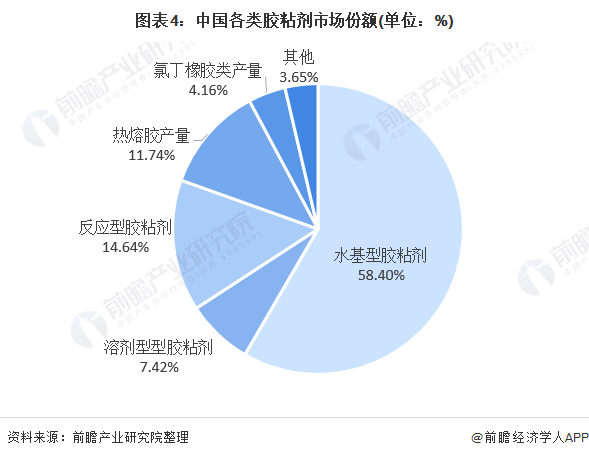
Based on research on the current status and trends of the domestic adhesive industry, combined with the production of various types of adhesives, we got the market share of different adhesives in China. As shown in the chart below, water-based adhesives have the highest share, reaching 58.40%.
The idea of environmental protection is deeply ingrained, and high-performance eco-friendly adhesives have a promising future.
In recent years, the concept of protecting the environment and cherishing resources has become more and more widespread. High-performance eco-friendly adhesives, thanks to features like high solid content, solvent-free, water-based, and UV curing, are expected to gradually replace traditional low- and mid-grade adhesives. At the same time, with the development of industries like new energy, electronics, machinery, automotive, and aerospace, both the production and demand for adhesives are showing a diversified trend.
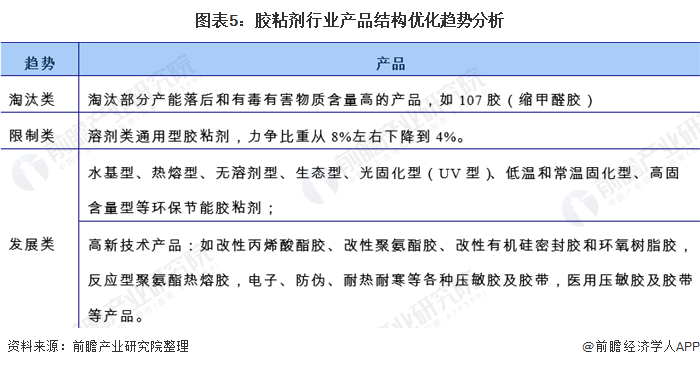
In the future, China will gradually phase out backward production capacity and low-quality products, limit the growth of general-purpose products with severe overcapacity, and promote the development of various high-tech products such as modified, special, reactive, and nano adhesives. The adhesive industry will see an optimization of product structure and an upgrade in quality.
In addition, the adhesive industry will also move towards larger scale and more intensive development in the future. Currently, most adhesive companies in China are relatively small, and there are even some workshop-style small businesses. They mostly produce low-end products and make modest profits through mass production and low-margin, high-volume sales. However, rising raw material prices and increasing labor costs have greatly squeezed their profit margins. As the industry consolidates, many of these companies will likely be targets for acquisition and merger.
With the continuous tightening of environmental and safety regulations, many adhesive companies that are not in chemical parks and cannot meet safety standards will gradually exit the market. Driven by safety and environmental policies, China’s adhesive industry is gradually shifting towards a more concentrated structure. Small and numerous small and medium-sized enterprises will find it hard to survive in the low-margin, low-end product market, so scaling up will be the trend for future development.
The above data comes from the 'China Adhesive Industry Production, Sales Demand, and Investment Forecast Analysis Report' by Qianzhan Industry Research Institute. Qianzhan also provides solutions including industry big data, industry planning, project applications, industrial park planning, investment promotion, IPO feasibility studies, and drafting of prospectuses.

